
I know almost nothing regarding Buoys Lamps by designer Postler Ferguson beyond the obvious fact that they are so wonderful they're beyond meaningful criticism. And also, as "art," they're not functionally for sale.
Thứ Ba, 14 tháng 7, 2020

Yemen Architectural Treasures We Shouldn’t Bomb Into Oblivion

The U.S. reopened its embassy in the Middle Eastern country of Yemen yesterday but warns it’s still a major threat due to terrorists being harbored within its borders. Wait a second, where have we heard this before? Oh, yeah…and six years later, important archaeological sites are still getting pilfered in Iraq. Yemen might be a potential hotbed of terrorism, but it turns out it’s also an extremely important country for architecture and urban development, including several protected World Heritage Sites. Let’s take a tour, shall we?
Our first stop is Shibam, a walled city nicknamed the “Manhattan of the desert” for its 16th-century skyscrapers, some of which are as tall as eight stories. The city was built on a mound to protect it from a flooding river nearby, which also led to the unique height of its buildings. This meticulously-designed city with its tall, mudbrick towers and narrow streets is one of the earliest and best preserved examples of vertical architecture and urban planning.

Zabid, a historic town dating to 820 that’s positioned close to Africa, is the site of an ancient Islamic university, supposedly where the term ‘algebra’ was coined. The Great Mosque of Zabid was constructed in the 9th century and, like other buildings in town, is notable for its whitewashed baked-brick walls and carved stucco facades and doorways with intricate, geometric patterns (fitting for a university town).
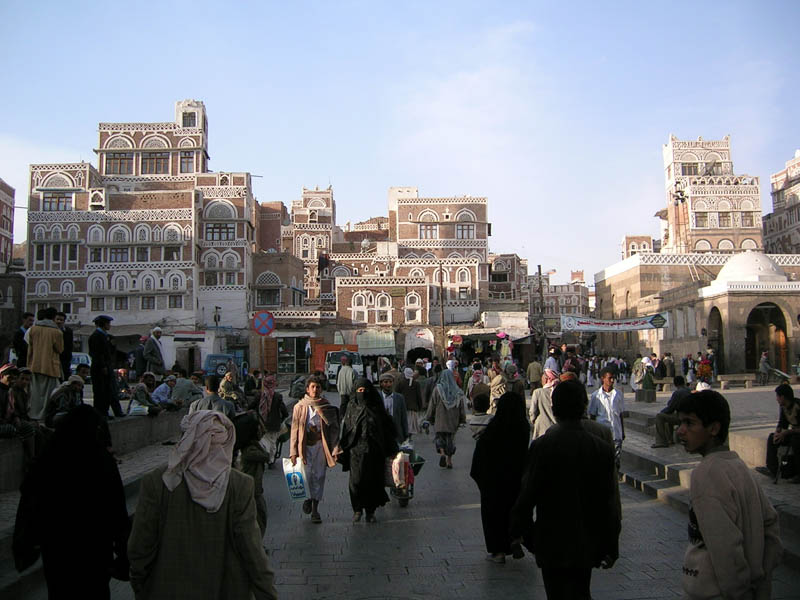
Back in Sana’a, Yemen’s capital–where those embassies are located–you’ll find a thriving metropolis that’s been inhabited for over 2,500 years. The old town is also a protected World Heritage site with incongruously tall, rammed earth towers connected by maze-like streets. The structures are covered with elaborate decorative white trim, creating a landscape that’s more akin to piped-icing on gingerbread houses. GOOD found this amazing interactive panoramic shot of the city at sundown and there are also some incredible shots of local markets and residences.
But even architectural protection doesn’t mean they’re safe. Two of these cities, Shibam and Sana’a, saw a series of terrorist attacks in March, where several Korean tourists were killed by Al-Qaeda militants. And all three sites are threatened due to poverty and unrest in the country. Let’s not toss a war in there, too, okay?
Shibam image by World Buildings; Zabid and Sana’a by UNESCO
Going Green in New York: One Co-op’s Story
IT was the sight of apartment buildings in New York City belching plumes of black smoke into the sky that spurred Diane Nardone into action.
As board president of the Brevoort, a 1955 co-op tower in Greenwich Village, Ms. Nardone started her campaign to turn the building green about three years ago.
Since then, the building has spent nearly $6 million. The projects ranged from the prosaic, like new windows and light bulbs, to the ambitious, like green roofs, converting from heating oil to natural gas, and installing a $3.2 million cogeneration plant capable of powering the 20-story building in a citywide blackout.
The extent of the work and the amount spent in such a short time are unusual. But board members say the building is now a model of energy efficiency and proudly note that other co-op boards have come to see what it has done.
The Brevoort’s timing was good.
In April, Mayor Michael R. Bloomberg announced new heating oil regulations for thousands of buildings across the city. Now those buildings — most of them apartment houses — are reviewing their heating systems.
The new rules require that by 2015, about 10,000 buildings switch from No. 6 heating oil, the cheapest but also the dirtiest fuel available, to No. 4 heating oil. Some buildings need to make the change as early as next July. But since buildings will be required to use either No. 2 oil or natural gas by 2030, many building owners are contemplating making the larger change now to avoid two separate conversions. Natural gas currently costs about 30 percent less than fuel oil.
City officials say that the soot pollution created by the 10,000 buildings that use No. 6 oil exceeds the amount created by all the cars and trucks in the city. At a seminar given by the Real Estate Board of New York earlier this month, a representative from the mayor’s office said that while converting to natural gas can be expensive, switching from No. 6 to No. 4 oil could cost a building as little as $7,000. But contractors and consultants in the audience challenged that figure, saying it represented a best-case scenario — a building whose equipment needed only minimal upgrading.
David Kuperberg, the chief executive of Cooper Square Realty, which manages about 450 buildings in New York City, described the extent of the work and the amount invested at the Brevoort as “the exception by a long shot.”
He said his company had urged the owners of its buildings to make similar changes, “but there is a great deal of skepticism and people just don’t believe the savings are there.” Most co-op and condo boards, he said, would rather make incremental changes and take on one project at a time.

About 100 of Cooper Square’s 450 buildings use No. 6 oil. “We’re in front of all our boards now,” offering advice and information on what needs to be done, Mr. Kuperberg said. Wherever possible, Cooper Square encourages gas conversion. But “the initial cost scares off a lot of buildings,” even though “we could prove the economics.” He pointed out that the savings from gas conversion could pay for the upfront costs in a few years.
The changes at the Brevoort did not come without pain.
Vigorous efforts were made to unseat board members in the last two elections, with some unhappy residents likening members to harsh and unyielding prison wardens.
But opposition candidates came shy of the votes they needed in both elections, and Ms. Nardone was re-elected this spring to her sixth term.
The switch from No. 6 oil to natural gas cost the Brevoort $225,000. It involved replacing the burner on the boiler, removing two 20,000-gallon oil tanks, and installing equipment to draw gas from the available Consolidated Edison pipeline. The board expects to save as much as $70,000 a year in fuel costs.
Ms. Nardone said that when she started exploring the conversion a few years ago, she knew the city was contemplating the regulation. “We realized that if we waited until it was required,” she said, “everybody would be knocking on Con Ed’s door at the same time and there would probably also be a shortage of contractors and a spike in prices.”
Property managers and environmental experts say that gaining access to gas pipelines maintained by a utility like Con Ed or National Grid could be a huge hurdle for some buildings. As Isabelle Silverman, a lawyer with the Environmental Defense Fund, put it, “The infrastructure to bring gas lines to the buildings definitely has to be built out, and we don’t know how long that would take.”
City officials say that is why the imminent rule change is for No. 4 oil and the natural gas requirement does not kick in for 20 years.
Most buildings are already hooked up for cooking gas. But long stretches of pavement may need to be ripped up to connect a building to the pipelines for heating gas, which are larger in diameter. “When you can get it and how much it will cost depends on where your building is relative to the gas line,” Ms. Silverman said.
Of the roughly 100 residential buildings managed by Rose Associates, 6 are in the process of converting to natural gas. J. Brian Peters, a senior managing director at Rose, said that “the due diligence on this really pans out, and there is a track record that shows the savings and benefits are real.”
Getting permits and physically converting the equipment takes four to six months, he said, but how quickly Con Ed can hook up a building is less certain.

For the 15-story co-op at 910 Park Avenue, converting the burner to accept either No. 2 fuel or gas took less than six months and cost $73,000. The work was done in October, but the building burned No. 2 oil all winter, while it waited six months for Con Ed to connect its gas line.
Jerry Cohen, a board member, said he had started considering the conversion after learning that No. 910 Park was on the Environmental Defense Fund’s “Dirty Building” list. “I was appalled,” he said. “So I ran a spreadsheet and it showed that in three years, the savings would give us payback on the cost of the conversion.” The board approved the plan unanimously.
Con Ed waived the $23,000 cost of connecting Mr. Cohen’s building to a pipeline that runs along Park Avenue because the building committed to using Con Ed’s gas exclusively.
Mr. Cohen’s building was lucky. He said that a friend at a building on Madison Avenue had recently learned that connecting to a pipeline would cost $1 million.
Joseph McGowan, the manager for gas sales at Con Ed, said that Con Ed would install up to 100 feet of pipe free to a building with five or more apartments, and could waive the fee for more, depending on the utility’s anticipated revenues from the building.
Hypothetically, he said, the cost to connect a building at, say, Fifth Avenue and 42nd Street, to the appropriate pipeline along First Avenue could be as high as $3 million. “Just think about having to trench along 42nd Street for that many blocks,” he said.
But if Con Ed found that seven additional large buildings along that route also wanted to convert to gas, “the revenue from all those buildings could take care of the cost.”
It has taken the co-op board at 12 East 97th Street about a year to weigh the benefits and figure out the cost of gas conversion. John Slattery, the vice president of the board, said the building was now close to signing contracts and expected a bill of $100,000 to $200,000. “All of this goes agonizingly slow,” he said, “because like most boards, we only meet once a month.”
Mr. Slattery says the building is trying to decide whether to go with a gas-only contract or to spring for the option of using both oil and gas. “It seems like most major property holders are doing dual fuel,” he said. “Maybe they’re just belts-and-suspenders people, but in today’s world, who knows what’s going to happen with the price of gas or oil?”
Myriad calculations and unknowns complicate the decision making. “The real problem is there are a lot of variables out there,” said Paul Gottsegen, the president of Halstead Management, which manages about 200 apartment buildings. “At this point, people are scrambling for the best ideas and the cheapest and greenest options.

“Who isn’t for cleaner air?” Mr. Gottsegen added. “But I’m afraid there are going to be a lot of buildings making hasty or expensive decisions and not actually choosing the best options, because we don’t really know what the best options are right now.”
To encourage gas conversion, utility companies are creating incentive programs and the state this year provided $6.5 million in grants to about 240 buildings. Francis J. Murray Jr., the president of the New York State Energy Research and Development Authority, said applications poured in and the money was spoken for shortly after the fund was announced in April.
“The demand clearly exceeded what was available,” Mr. Murray said. The agency is seeking other funding sources and hopes to offer more grants next year.
The state agency also provides grants for cogeneration plants, which burn gas to produce both heat and electricity, and this year distributed $20 million to 19 projects across the state, including three residential buildings managed by Rose Associates. Mr. Peters of Rose said that for certain buildings, it made sense to put in cogeneration at the same time as a gas conversion.
“It depends on the scale and the unique character of the property,” Mr. Peters said, adding that one of Rose’s rental properties, London Terrace Gardens, installed cogeneration about six years ago and saves about 15 percent on electricity annually.
Correction:
In an earlier version of this article, a picture caption misidentified the board vice president of 12 East 97th Street. His name is John Slattery, not Jerry Cohen.
Correction:
An article last Sunday about 10,000 buildings in New York City that are facing the need to switch to cleaner heating oil misstated, in one reference, the surname of a senior managing director at Rose Associates, which owns and manages buildings. He is J. Brian Peters, not “Mr. Rose.”
Indonesia - Aceh Afterwards
As pictures emerged earlier this year of the earthquake devastation in Haiti the images of loss, anguish and destruction were chillingly familiar. We'd seen this before and on our own doorstep.
The tsunami, which slammed into coastal communities from Thailand to Sri Lanka and beyond exacted its most appalling toll in Aceh, Indonesia where about 170,000 people were killed.
Once the epic scale of the disaster became apparent Australia and other nations around the world pledged help and billions in aid. The destructive surge of the sea had been replaced with a well intentioned surge of global support.
Indonesia Correspondent Matt Brown has discovered that rebuilding effort has been chaotic and in places very uneven. He meets former merchant banker turned hands-on helper Sara Henderson who learned quickly not to make the same mistakes as some aid agencies that had constructed homes for non-existent villagers.
"When I was designing the houses I though oh how great I'll give them an inside bathroom, I'll give them an inside kitchen oh this is going to be wonderful and when they saw the plan they were horrified and they said no, no, no, no they didn't want the bathroom inside, they didn't want the kitchen inside and so I think listening is very, very important."
SARA HENDERSON
But Matt's also discovered - as if it were possible - one very positive consequence of the Boxing Day tsunami. It served to wash away a divisive, bitter and protracted civil war.
It quickly became to clear to everyone from the Indonesian Government to the rank and file of the separatist movement GAM that only peace and cooperation would see Aceh emerge from the rubble of flattened communities.
GAM guerrillas put down their weapons , Jakarta pulled back its soldiers, a deal was cut for limited autonomy and former separatists like Nurdin Abdul Rahman took the reins of devastated districts.
"The tsunami had alerted the people of Aceh that this is the only chance for better
life, for peace for Acehnese."
NURDIN ABDUL RAHMAN
Now though, there are signs the goodwill that followed the tsunami is giving way to tension and former GAM foot soldiers who now believe Jakarta has welched on its side of the deal and are contemplating a return to their armed push for independence. Elsewhere there are signs of a festering Moslem militancy and Foreign Correspondent has obtained video of the worrying activities of one such group.
Further information
For details or to donate to Sara Henderson's foundation Building Bridges to the Future
Indonesia’s Poor Welcome Sea Refugees
IDI RAYEUK, Indonesia — The only solace for the almost 200 men living in a squalid refugee camp here is the freedom they now have to pray.
“In Myanmar, if we pray, we are killed,” said Alam Shah, 38, a member of the Rohingya Muslim minority, who fled the predominantly Buddhist Myanmar last year. “I’m scared they will send us back there. It is a very, very dangerous country.”
The Rohingya here were found floating at sea on Feb. 2, after having spent three weeks aboard a wooden boat with no motor, no food and no water. When they were found by an Indonesian fisherman off the coast of Aceh, Indonesia’s northernmost province, many were close to death.
A few months before, another boat with about 200 Rohingya refugees landed in Sabang, on the northern tip of Aceh, where they are now being held at a naval station. Several more boats were found by the Indian coast guard carrying almost 400 Rohingya.
Research by nongovernmental organizations suggests that all the refugees had passed through detention camps on islands just off the coast of Thailand. According to interviews with the refugees, the Thai military towed and abandoned at least six boats at sea between November and January, when the international news media picked up the story and the so-called push-backs were halted.
The expulsions reversed a policy in which Thailand had allowed thousands of Rohingya to land in recent years, mostly on their way to Malaysia. The Thai military had denied accusations of pushing the refugees out to sea, but Prime Minister Abhisit Vejjajiva of Thailand said in February that some boats had been towed out to sea and that he intended to investigate.
About 1,200 men are known to have been pushed out to sea, more than 300 of whom drowned, according to the Arakan Project, a nongovernmental human rights group. There are fears, however, that many more Rohingya from Bangladesh and Myanmar, formerly Burma, are still missing.
“It is difficult to say what the exact numbers are,” said Chris Lewa, an expert on Rohingya issues who runs the Arakan Project. “But based on the interviews we have done with refugees that have ended up in India and Indonesia, we think there were many more push-backs than have been confirmed.”
“What does seem clear,” Ms Lewa said, “what is consistent among all the interviews we have done with the refugees, is that they were detained on islands off the coast of Thailand before being towed out to sea and set adrift by the Thai military.”
Last week, after months of delays, the United Nations began the process of “status determination” for the 391 men being held in Idi Rayeuk and Sabang. The process, a series of interviews with refugees, will determine if they are in need of protection and can stay in Indonesia, or if they are economic migrants who should be returned to Myanmar.
At the same time, on the resort island of Bali, leaders from around Southeast Asia, including from Myanmar, are beginning discussions about regional migrants, including the Rohingya.
Indonesia, which regional analysts have praised for its leadership in matters like human rights, disaster reconstruction and other issues involving Myanmar, fears a flood of thousands of Rohingya to its shores if the men in Aceh are allowed to stay.
“Indonesia is trying to play a leadership role in this situation,” said Lilianne Fan, a humanitarian worker who has worked in Aceh and Myanmar and is now advising the Acehnese governor.
“Compared to other regional governments, the Indonesians have responded very well, especially since they have engaged international organizations,” she said.
The United Nations estimates that about 723,000 Rohingya live in Myanmar, where the military government considers them foreigners and denies them citizenship, passports or the right to own land. There are also hundreds of thousands of Rohingya living in Bangladesh.
The Rohingya in Myanmar live mostly in the northern state of Rahkine and in the past fled through Bangladesh and into the Middle East. But new travel restrictions imposed by Bangladesh’s government have forced the Rohingya to find alternative destinations like Thailand, Malaysia and Indonesia.
The process of status determination and the negotiations that will need to take place between Myanmar and Indonesia could take many months. Meanwhile, the few aid organizations in Idi Rayeuk are concerned that the camp is not equipped to house refugees for long.
The men were greeted generously by the local Acehnese, many of whom live in abject poverty themselves but can relate to the Rohingya’s situation. Many Acehnese here have family members who were forced to flee a separatist conflict that raged in Aceh for 30 years until a peace agreement was reached in 2005. Idi Rayeuk, in fact, was once a central launching point for Acehnese trying to flee the country.
“The support has been unreal and an inspiration for the rest of the world,” said Sara Henderson, president of the Building Bridges to the Future Foundation. “They are still giving free fish to the camp when they have barely enough to eat themselves.”
But the generosity of the Acehnese and the local government is nowhere near enough, Ms. Henderson said. The men still live in tents on wet, muddy ground. Sanitation, food and water remain basic, and security is almost nonexistent. Seven men fled the camp last Monday morning, apparently afraid they were about to be deported, but they were all later caught.
Several of the refugees are also suffering from serious health problems, like tuberculosis, but the camp lacks qualified doctors and money for health care.
The Building Bridges to the Future Foundation, which was founded in response to the December 2004 tsunami in Aceh, has been pressing for donations to help coordinate the camp and provide necessary logistical support. The local government has offered to provide a larger plot of land if money can be raised for necessities like temporary barracks, sanitation and food.
“The local community and the government do not have the funds to support a refugee camp of 198 men,” Ms. Henderson said. “They barely, and rarely, have the funds to take care of themselves.”
Thứ Hai, 13 tháng 7, 2020
Reclaiming the streets
A social enterprise is giving unemployed people design and carpentry skills, and winning council contracts for its outdoor furniture

After narrowly escaping an amputation and spending a year laid up, Bedia decided it was time to take a new direction in his life. So he signed up to Furniture on the Street (FoS), a social enterprise in Tower Hamlets, east London, which supplies local authorities, charities and other clients with contemporary-designed pieces of outdoor wooden furniture.
The initiative provides unemployed people of all ages with a one-year course in carpentry, feeds those skills into the business, and runs workshops for young people to learn about the design process.
"My grandad was a carpenter, so I've always had an interest, but I had no qualifications on paper," Bedia says. "For a year, I wasn't able to walk, and for two years I was on crutches. I'm a really active person, so my self-esteem was very low. But the course was really hands-on, and the camaraderie was brilliant."
Bedia got health and safety certificates and a second NVQ on the course and since finishing has set up a business fitting interiors with two friends, and has just finished a long contract.
Fellow trainee Mukesh Patel, 33, was doing odd building jobs when he heard about FoS. He has designed two benches, one of which - the Lucky 7 - has proved a very popular product. "I really enjoyed using tools that I didn't know how to use before," he says.
Thirty-seven trainees have undertaken the course, which was set up in 2005 by Old Ford housing association in the borough, initially to engage the Bangladeshi community. A year later, it was turned into a social enterprise to make it sustainable in the long term and open to anyone.
FoS managers say it is special because it provides customers with a complete community package. The initiative also has an environmental focus, using reclaimed wood to create benches, bins and planters.
"One of the key things as a supplier of contract furniture is that there aren't any who also run youth development schemes and reclaim wood," says Rick Levene, lead designer for FoS. "It's a whole package that is community orientated."
Workshop activities include model-making, teaching basic computer-aided design software skills, and visits to timber yards.
In one project on the Aylesbury estate, in Southwark, south London, trainees worked with eight young people to produce three bright, multi-coloured benches for the estate. After choosing the bench frame, the group worked on the graphic designs that would be painted on to the furniture. The benches were built by the trainees before being painted by the young people.
"The majority of the young people were from what some class as 'hard to reach' - close to exclusion from school or involved in antisocial behaviour," says Nigel Days, a youth officer for Aylesbury's New Deal for Communities programme. "It was a seriously cantankerous group, to say the least. I didn't have much confidence, but it was amazing. They turned up all the time, on time. And the knowledge base they come away with is fantastic."
Leanne Baxter, FoS project manager, says that while their biggest clients have been charities and local authorities - the largest single order, 10 benches, was from Camden council, north London - it would be wrong to attribute this just to goodwill. "We use local labour, our frames are made locally, and we have an environmental focus," she says. "You're not doing us a favour. You get a competitive product."
In the three years that it has been running, Levene says, FoS has grossed over £100,000, and apart from a contribution by Old Ford towards two staff salaries, it is entirely run on profits. Former and current trainees are also paid for their work.
Baxter says that all the trainees have gone on into education, employment or self-employment and one received an offer of a place at university to study furniture design after a tutor saw his bench.
"The workshops give the young people a sense of confidence because some of them have never been given the power or responsibility to make decisions that affect the environment they live in," Baxter says. Old Ford is now considering extending the scheme to fencing and metalwork, and franchising the idea to other community-minded associations.
• furnitureonthestreet.org
• furnitureonthestreet.org
Thứ Năm, 9 tháng 7, 2020
How To Install and clean Hardwood Floors
“Depending on the type of hardwood flooring you’re installing, you may need different tools and materials,” says Tony Pastrana, installation systems developer at Armstrong Flooring. “You may need a pneumatic flooring nailer, drill and drill bits, hammer, nails, pry bar and saw.” Consult the instructions included with yout flooring and make sure you have all tools ready and within reach.

Tools and Materials
“Depending on the type of hardwood flooring you’re installing, you may need different tools and materials,” says Tony Pastrana, installation systems developer at Armstrong Flooring. “You may need a pneumatic flooring nailer, drill and drill bits, hammer, nails, pry bar and saw.” Consult the instructions included with yout flooring and make sure you have all tools ready and within reach.
More: https://www.buzzfeed.com/mocphatcontruction
HOW TO CLEAN A COMPOSITE OR WOOD DECK
Designing and building a deck suited to your wants and needs can be fun and exciting. But when it comes to care and maintenance, it’s important to know what you’re getting yourself into beforehand. Examine the pros and cons of composite or wood decking -- specifically when it comes to how to clean your decking. And in addition to routine cleaning, you should also be aware of other maintenance work you may need to do from time to time on your deck.
For natural wood lovers, properly cleaning a wood deck requires annual care. You can buy deck cleaning solution at your local hardware store or make your own homemade concoctions from various household products that are effective in fighting mildew, algae, oil and debris.
In addition to cleaning, you’ll also need to routinely stain or seal your natural deck to keep it looking fresh and protect it from the harsh effects of elemental damage -- mainly heat and moisture. In some cases, your natural wood deck may also splinter, requiring sanding or replacing loose boards from time to time.
Composite decks on the other hand, offer a lower level of all-around maintenance – they won’t splinter and you don’t need to worry about periodic staining, painting or sealing projects.
Tools and Materials
“Depending on the type of hardwood flooring you’re installing, you may need different tools and materials,” says Tony Pastrana, installation systems developer at Armstrong Flooring. “You may need a pneumatic flooring nailer, drill and drill bits, hammer, nails, pry bar and saw.” Consult the instructions included with yout flooring and make sure you have all tools ready and within reach.
More: https://www.buzzfeed.com/mocphatcontruction
HOW TO CLEAN A COMPOSITE OR WOOD DECK
Designing and building a deck suited to your wants and needs can be fun and exciting. But when it comes to care and maintenance, it’s important to know what you’re getting yourself into beforehand. Examine the pros and cons of composite or wood decking -- specifically when it comes to how to clean your decking. And in addition to routine cleaning, you should also be aware of other maintenance work you may need to do from time to time on your deck.
For natural wood lovers, properly cleaning a wood deck requires annual care. You can buy deck cleaning solution at your local hardware store or make your own homemade concoctions from various household products that are effective in fighting mildew, algae, oil and debris.
In addition to cleaning, you’ll also need to routinely stain or seal your natural deck to keep it looking fresh and protect it from the harsh effects of elemental damage -- mainly heat and moisture. In some cases, your natural wood deck may also splinter, requiring sanding or replacing loose boards from time to time.
Composite decks on the other hand, offer a lower level of all-around maintenance – they won’t splinter and you don’t need to worry about periodic staining, painting or sealing projects.
Đăng ký:
Bài đăng (Atom)
-
Ngày nay, việc sử dụng sàn gỗ là một xu thế cực kỳ hot trong ngành nội thất. Bởi tính chất và tính thẩm mỹ rất quan trọng của sàn gỗ. Một t...
-
Để hoàn thiện được một công trình lát sàn gỗ đảm bảo tính thẩm mỹ và đạt chất lượng cao, thì bước thi công sàn gỗ đúng kỹ thuật là vô cùng...


